



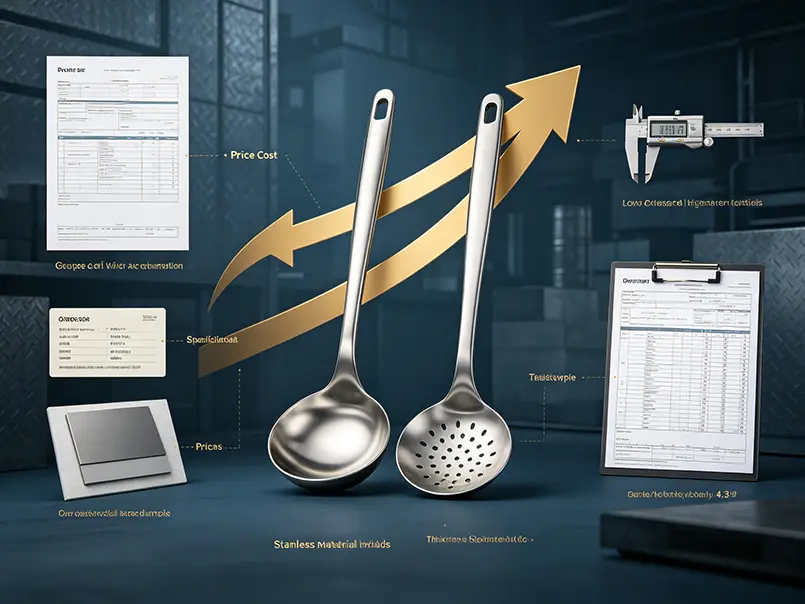
If you are sourcing stainless steel kitchenware from overseas suppliers, you may notice a common issue: products that look almost identical can come with significantly different prices.
At first glance, this price gap can be confusing, particularly when suppliers provide similar product photos, specifications, and descriptions. Naturally, buyers may ask:
- Why is Supplier A much cheaper than Supplier B?
- Does a lower price always mean lower quality?
- Which factors actually determine the cost of a stainless steel product?
- How can buyers compare quotations more accurately?
In practice, stainless steel pricing depends on much more than the appearance of the finished item. Material grade, thickness, surface treatment, polishing, edge finishing, production processes, and quality standards can all influence the final quotation.
By understanding these factors, importers and wholesale buyers can evaluate supplier quotations more effectively and avoid making purchasing decisions based on price alone.
1. Material Grade: One of the Most Important Price Factors
Among all the factors affecting stainless steel pricing, material grade is one of the most important starting points.
Different grades offer different levels of corrosion resistance, mechanical strength, durability, and suitability for particular applications. At the same time, their raw-material costs can vary considerably.
As a result, two products with almost identical shapes may have very different material costs simply because they are manufactured from different grades of stainless steel.
Common Stainless Steel Grades Used in Kitchenware Production:
Several stainless steel grades are commonly encountered in kitchenware and related products.
- 316 stainless steel – A premium grade with excellent corrosion resistance. It is generally used where higher resistance to corrosive environments is required, but its material cost is also significantly higher.
- 304 (18/8) stainless steel – A widely used stainless steel grade with good corrosion resistance and durability. It is commonly selected for food-contact kitchenware and products positioned toward the mid- to high-end market.
- 430 (18/0) stainless steel – A more economical stainless steel grade often used for kitchenware and household products where extremely high corrosion resistance is not required.
- 410 stainless steel – A martensitic stainless steel valued for its hardness, strength, and wear resistance. It generally offers lower corrosion resistance than austenitic grades such as 304, but can be suitable for applications where strength and durability are key considerations. For food-contact components, the specific application, surface finish, and applicable food-contact requirements should be verified with the manufacturer.
- 420J2 stainless steel – A harder martensitic grade commonly used for applications requiring greater hardness and edge retention.
- 2Cr13 stainless steel – A commonly used martensitic stainless steel grade that offers a balance of hardness, strength, corrosion resistance, and cost. It can be used in components where hardness is more important than high corrosion resistance. For food-contact parts, compliance should be verified against the regulations and requirements of the target market.
- 2Cr14 stainless steel – A heat-treatable martensitic stainless steel grade used in applications where hardness, strength, and moderate corrosion resistance are required. Its suitability depends on the specific product design and application. For food-contact parts, the material should be evaluated against the applicable regulations and requirements of the target market.
- 201 stainless steel – A lower-cost austenitic stainless steel that uses manganese and nitrogen as partial substitutes for nickel. It can provide good strength and is suitable for various general-purpose applications, although its corrosion resistance is generally lower than that of 304 stainless steel, particularly in more demanding environments. For food-contact parts, compliance should be verified against the regulations and requirements of the target market.As a general comparison, corrosion resistance can be broadly represented as:
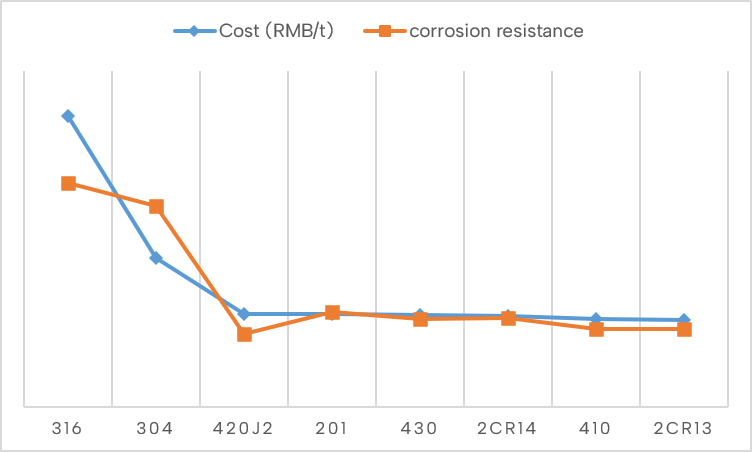
As a broad comparison, corrosion resistance can be represented approximately as:
For corrosion resistance: 316 > 304 > 201 > 430 ≈ 2Cr14 > 410 ≈ 2Cr13 ≈ 420J2
For cost: 316 > 304 > 420J2 ≈ 201 > 430 > 2Cr14 > 410 ≈ 2Cr13
However, this ranking should be treated as a general reference rather than an absolute rule. Actual performance depends on factors such as chemical composition, processing, surface condition, and the environment in which the product is used.
Material costs also vary considerably between grades. The indicative figures below illustrate how the choice of stainless steel can affect raw-material costs:
| 316 | 304 | 420J2 | 201 | 430 | 2Cr14 | 410 | 2Cr13 | |
|---|---|---|---|---|---|---|---|---|
| Cost (RMB/t) | 26000 | 13300 | 8320 | 8300 | 8200 | 8100 | 7900 | 7800 |
The figures above are indicative reference values rather than fixed market prices. Actual stainless steel prices vary according to market conditions, supplier, thickness, surface condition, quantity, and other specifications.
Why Material Verification Matters
Although the material grade has a major effect on cost, it cannot be reliably identified simply by looking at the finished product.
For instance, a 304 stainless steel utensil and a lower-cost stainless steel utensil may have almost identical shapes and finishes. Underneath that similar appearance, however, their performance, corrosion resistance, and material costs can be quite different.
For this reason, buyers should specify the required material grade clearly in their product specifications. Where necessary, material testing or supplier documentation can provide additional confirmation instead of relying solely on visual inspection.
2. Surface Finishing: More Than Just Appearance
Once the material has been determined, surface finishing becomes another important part of the cost equation.
Beyond visual appearance, the chosen finish can influence perceived quality, cleaning characteristics, and product positioning. Consequently, products made from the same stainless steel grade may still receive noticeably different quotations.
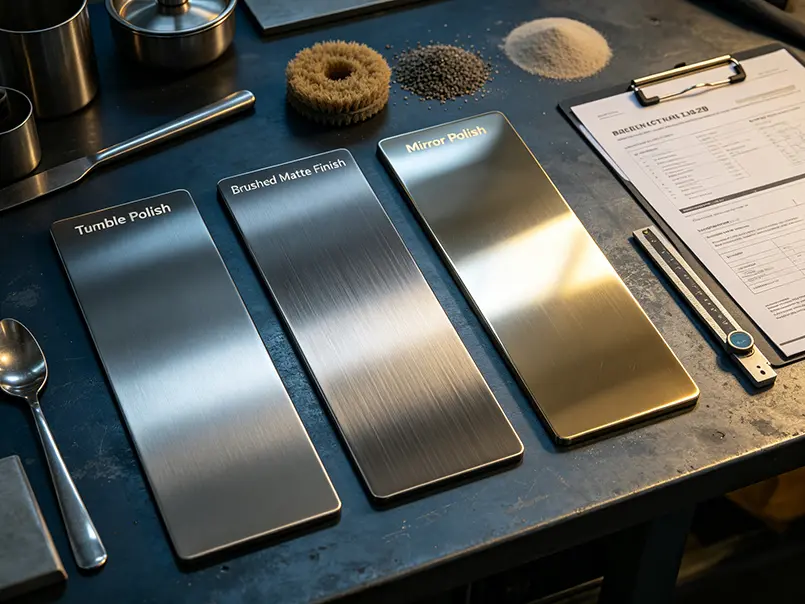
Common finishing methods include:
- Tumble polishing – A relatively cost-efficient process often used for mass-produced items.
- Matte or brushed finish – Creates a more understated, modern appearance and is commonly used for contemporary kitchenware.
- Mirror polishing – Produces a highly reflective surface and generally requires more processing to achieve a consistent appearance.
For buyers, specifying the desired finish in detail is therefore more useful than simply asking for a “polished” product.
3. Polishing Quality: Not All Shine Is the Same
Surface finishing alone does not tell the whole story. The quality and level of polishing can also have a significant effect on production cost.
Typically, polishing involves abrasives with different grades or grit levels. Coarser abrasives are used to remove surface imperfections, while progressively finer abrasives help create a smoother and more refined surface.
As the required finish becomes more demanding, manufacturers may need:
- Additional processing time
- More labor
- More polishing stages
- Greater inspection requirements
- Higher rejection risk when surface defects are visible
Consequently, a high-quality mirror finish may cost considerably more than a basic polished surface, even when both products use the same stainless steel grade.
This difference becomes particularly noticeable on products with large visible surfaces or complicated shapes. In such cases, maintaining a uniform finish throughout the entire product requires greater process control.
4. Edge Finishing: A Small Detail with a Big Impact
Another detail that can easily be overlooked during sourcing is edge treatment.
For kitchenware, edge quality directly affects how a product feels and performs during everyday use. Rough or poorly processed edges may feel uncomfortable, whereas properly finished edges provide a smoother and safer user experience.
Depending on the product structure, edge treatment may include:
- Deburring
- Grinding
- Rounding
- Polishing
- Additional inspection
Although each individual step may appear relatively minor, the additional labor and processing time can increase the overall manufacturing cost.
Therefore, edge requirements should be included in the product specification and quality-control standards, particularly for utensils, kitchen tools, containers, and other frequently handled products.
5. Additional Surface Treatments
Mechanical polishing is not suitable for every stainless steel surface or product structure. For certain applications, manufacturers may instead use additional surface-treatment processes.
Electropolishing
Electropolishing removes a controlled amount of material from the surface through an electrochemical process. When properly applied, it can improve surface smoothness and may enhance corrosion resistance and cleanability.
Because the process requires additional equipment and processing, electropolishing generally adds to manufacturing costs.
Chemical Polishing
Chemical polishing uses chemical solutions to improve surface uniformity and brightness. It may be considered for particular components or applications where conventional mechanical polishing is difficult or inefficient.
Ultimately, the appropriate treatment depends on the product structure, stainless steel grade, required appearance, and intended application.
6. Stainless Steel Raw Material and Pre-Polished Sheets
Surface quality can also be influenced before production even begins, starting with the condition of the stainless steel raw material.
Stainless steel sheets are available with different surface finishes, and higher-quality pre-polished materials may carry a higher raw-material cost.
At first, using pre-polished sheets may appear to be an effective way to reduce downstream processing. Nevertheless, a pre-polished surface does not automatically guarantee a better finished product.
During cutting, forming, welding, assembly, and transportation, the material can be exposed to:
- Scratches
- Dents
- Pitting
- Surface contamination
- Deformation
- Other forms of surface damage
As a result, manufacturers may still need additional polishing or surface treatment after production to restore consistency.
This is why specifying a “pre-polished stainless steel sheet” alone is not enough to define the final surface quality.
7. Product Structure and Manufacturing Process Also Matter
Material and surface treatment explain part of the price difference, but the manufacturing process itself can be equally important.
A simple stainless steel utensil may require only a few production steps. By comparison, a more complicated product could involve:
- Cutting or stamping
- Deep drawing or forming
- Welding
- Grinding
- Polishing
- Assembly
- Cleaning
- Inspection
- Packaging
Each additional operation can introduce labor, equipment, energy, tooling, and quality-control costs.
Moreover, products with tight dimensional tolerances or complicated structures may require more frequent inspections. They may also have higher production rejection rates if maintaining consistent quality is more difficult.
For this reason, buyers should determine whether two suppliers are actually quoting the same manufacturing specification, rather than comparing products based only on their appearance.
8. Quality Control Can Also Affect the Final Price
Manufacturing processes are only part of the picture. Quality control is another area where suppliers can differ significantly.
One supplier may use a relatively simple inspection procedure, while another may conduct checks at several stages of production. The difference may not be obvious from the quotation itself, yet it can influence both production costs and consistency.
Depending on the product, quality control may cover:
- Material verification
- Dimensions
- Surface defects
- Edge smoothness
- Welding quality
- Product function
- Assembly
- Packaging
- Final appearance
More comprehensive inspection does not automatically mean that a product is better. Nevertheless, clearly defined inspection standards can reduce the likelihood of receiving products that do not meet the agreed specifications.
For importers, the key is therefore to compare what is included in each quotation, rather than looking at the unit price in isolation.
Why Similar Products Can Have Very Different Prices
Once the above factors are considered together, the reason for large price differences becomes much clearer.
Two products may look almost identical while differing in several less visible areas:
| Cost Factor | Possible Difference |
|---|---|
| Stainless steel grade | 201 vs. 304 vs. 316 |
| Material thickness | Different weight and durability |
| Raw material surface | Standard vs. pre-polished |
| Surface finish | Tumble, brushed, matte, mirror |
| Polishing level | Basic vs. multi-stage polishing |
| Edge treatment | Basic deburring vs. refined finishing |
| Additional treatment | Mechanical vs. electrochemical processes |
| Product structure | Simple vs. multi-step manufacturing |
| Quality control | Basic vs. more detailed inspection |
| Packaging | Standard vs. customized retail packaging |
In other words, a lower quotation does not necessarily mean that a supplier is offering the same product at a better price. Instead, it may reflect different materials, specifications, production processes, or quality requirements.
How Importers Can Compare Stainless Steel Quotations More Effectively
Rather than asking only, “What is your best price?”, buyers can make supplier comparisons much more meaningful by confirming the main specifications first.
A practical checklist includes the following:
1. Confirm the Stainless Steel Grade
First, specify whether the product should use 304, 316, 430, 410, 420J2, or another grade.
2. Confirm Material Thickness
Next, check the required material thickness. Even when two products share the same dimensions, different thicknesses can result in significant differences in weight, durability, and cost.
3. Define the Surface Finish
After that, specify whether the required finish is brushed, matte, mirror-polished, or another surface treatment.
4. Clarify the Polishing Standard
If appearance is important, describe the expected surface quality rather than simply requesting a “polished” product.
5. Specify Edge Requirements
For products that are frequently handled, include edge smoothness and deburring requirements in the agreed quality standard.
6. Confirm the Inspection Standard
In addition, clarify which dimensions, functions, materials, and appearance characteristics need to be inspected before shipment.
7. Compare the Complete Specification
Finally, make sure the quotations are based on the same product structure, material, finish, packaging, order quantity, and quality requirements.
Only when these points are aligned does a unit-price comparison become genuinely meaningful.
Why Price Alone Is Not a Reliable Sourcing Standard
For importers and wholesale buyers, the lowest initial quotation may look attractive. However, the lowest purchase price does not necessarily translate into the lowest overall cost.
If a product fails to meet the expected material or finishing requirements, additional expenses may arise from:
- Quality claims
- Rework
- Replacement shipments
- Customer returns
- Delayed sales
- Packaging changes
- Damage to brand reputation
On the other hand, choosing the most expensive option is not necessarily the best solution either.
Instead, buyers should aim for a specification and supplier combination that provides the right balance of quality, performance, appearance, and cost for the target market.
A More Practical Way to Evaluate Supplier Quotations
When comparing suppliers, the most useful question is therefore not simply:
“Which supplier has the lowest price?”
A more practical question is:
“What specifications and production standards are included in this price?”
Once the material grade, thickness, surface finish, polishing requirements, edge treatment, manufacturing process, inspection standard, and packaging are clearly defined, quotations become much easier to compare.
More importantly, this approach helps buyers distinguish between a genuinely competitive price and a low quotation that is based on different specifications.
For international buyers, understanding what is included in the price can make supplier evaluation more transparent and help reduce unexpected quality and cost issues during mass production.
Conclusion
Ultimately, stainless steel kitchenware pricing is shaped by a combination of material, processing, finishing, manufacturing, and quality-control factors. Some differences are easy to see, while others remain hidden until the product is tested, manufactured, or used.
That is why buyers should look beyond both the product appearance and the number shown on a quotation sheet. A clearly defined specification provides a much stronger basis for comparing suppliers and determining whether a price is genuinely competitive.
For companies sourcing stainless steel kitchenware, the goal does not have to be finding the cheapest quotation. Instead, the focus should be on finding the right specification at a price that makes sense for the intended market.
At SOAR, we apply this approach when developing and manufacturing stainless steel kitchenware for international buyers, with attention to material selection, surface finishing, production consistency, inspection, and export requirements.
Understanding what is behind the price is often the first step toward making a more informed and reliable sourcing decision.